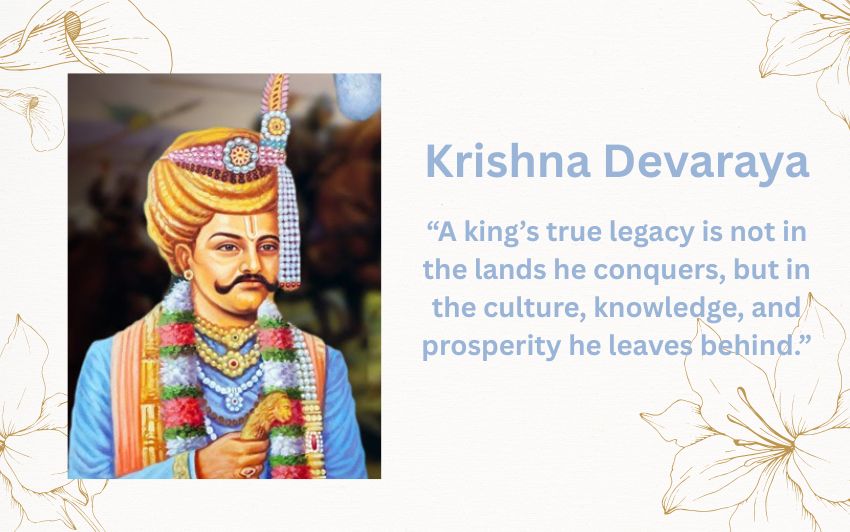
Krishna Devaraya (1509–1529) – The Magnificent Vijayanagara Emperor
Introduction
Krishna Devaraya, the illustrious ruler of the Vijayanagara Empire, is celebrated as one of the greatest monarchs in Indian history. Reigning from 1509 to 1529 CE, he is remembered not only for his military conquests but also for his unparalleled support of arts, literature, and culture. Known as a just and visionary leader, Krishna Devaraya transformed the Vijayanagara Empire into a formidable power in South India. He is often referred to as the “Andhra Mahadhipati” or “Great Lord of Andhra” due to his immense contributions to Telugu literature and culture.
Under his reign, the empire experienced a golden age, with prosperity, intellectual growth, and architectural marvels leaving a lasting legacy for future generations. His life reflects the perfect blend of courage, wisdom, and cultural sophistication.
Early Life and Background
Krishna Devaraya was born around 1471–1472 CE in Hampi, the capital of the Vijayanagara Empire. He belonged to the Tuluva dynasty, which rose to prominence under the leadership of his father, Tuluva Narasa Nayaka. Narasa Nayaka was a skilled general and administrator who effectively managed the empire during periods of political instability.
Growing up in a royal household, Krishna Devaraya received training in statecraft, military strategy, literature, and diplomacy. Despite the privileges of royal life, he developed a deep understanding of the challenges faced by common people and the complexities of governance. This early exposure shaped his vision of just rule and his determination to protect his subjects.
Krishna Devaraya’s early years were also influenced by the cultural richness of the Vijayanagara Empire. Surrounded by scholars, poets, and artisans, he developed a profound appreciation for languages, literature, and temple architecture—elements that would define his reign.
Accession to the Throne
Krishna Devaraya ascended the throne in 1509 CE, following the death of his father. At that time, the Vijayanagara Empire faced threats from neighboring kingdoms, especially the Bahmani Sultanates and the Gajapati Kingdom of Odisha. The empire also needed administrative consolidation to maintain stability and prosperity.
Krishna Devaraya’s accession marked the beginning of a period of exceptional leadership. His keen intellect, military acumen, and diplomatic skill allowed him to stabilize the empire, defend its borders, and prepare for expansion. Within a short period, he became known as a fearless and visionary ruler, earning respect from allies and adversaries alike.
Military Achievements
Krishna Devaraya was not only a patron of arts but also a formidable military strategist. His reign witnessed several successful campaigns that expanded the empire and secured its territories.
-
Conquest of the Eastern Territories:
Krishna Devaraya led campaigns against the Gajapati Kingdom of Odisha, defeating their armies and securing important eastern provinces. This strengthened Vijayanagara’s control over coastal Andhra Pradesh and parts of Odisha. -
Raichur Doab Campaigns:
He successfully fought the Deccan Sultanates, particularly in the Raichur Doab region. These victories ensured the empire’s dominance over critical trade routes and fertile lands. -
Navaratnas and Fortifications:
He fortified strategic locations, built strong military infrastructure, and maintained a disciplined army. The Navaratnas, or nine eminent ministers and generals, helped him administer the empire efficiently. -
Diplomacy and Alliances:
Krishna Devaraya skillfully used alliances, marriages, and treaties to maintain stability. He often combined diplomacy with military might to ensure peace and prosperity.
His military achievements not only expanded the empire but also ensured peace and stability, allowing economic and cultural growth to flourish during his reign.
Administration and Governance
Krishna Devaraya was a wise administrator who valued justice, efficiency, and the welfare of his subjects. His governance policies contributed to the prosperity and stability of the Vijayanagara Empire.
- Revenue and Taxation: He implemented an efficient revenue system, ensuring fair taxation and reducing exploitation of farmers. Agricultural prosperity increased under his careful management of irrigation and land reforms.
- Judicial System: Krishna Devaraya maintained courts and legal institutions that provided justice to all subjects. Disputes were resolved fairly, and law and order were strictly enforced.
- Infrastructure and Trade: He promoted trade, built roads and marketplaces, and encouraged urban development. Temples, tanks, and irrigation systems constructed during his reign enhanced both cultural and economic life.
- Support for Commoners: Despite being a mighty emperor, he was known for his accessibility. Farmers, merchants, and artisans found his rule benevolent and just, strengthening loyalty among his people.
Patronage of Arts and Literature
Krishna Devaraya is often remembered as a literary king, who elevated Telugu literature to new heights. His reign is regarded as the golden age of Telugu literature.
- Ashtadiggajas: He established a council of eight eminent poets, known as Ashtadiggajas, who created literary masterpieces that continue to be celebrated.
- Amuktamalyada: Krishna Devaraya himself was a poet and composed Amuktamalyada, a Telugu epic that narrates the story of the devotion of Andal, a Vaishnavite saint.
- Multilingual Contributions: He promoted literature in Kannada, Sanskrit, and Tamil as well, fostering a culturally rich and diverse environment.
- Architecture and Temples: Krishna Devaraya enhanced and commissioned temples such as Vijaya Vittala Temple and Hazara Rama Temple in Hampi. These architectural marvels remain a testament to his artistic vision.
His patronage not only encouraged scholars and poets but also enriched South Indian culture and identity.
Religious Policies
A devout Hindu, Krishna Devaraya respected all faiths and maintained religious harmony. He primarily promoted Vaishnavism, but also supported scholars of Shaivism and other traditions. Temples built or renovated during his reign became centers of learning, culture, and spiritual practice.
His religious policy reflected a ruler who believed in spiritual growth, cultural preservation, and social harmony as essential elements of governance.
Personal Traits
Krishna Devaraya was renowned for his courage, wisdom, and benevolence. He:
- Balanced diplomacy with military strength.
- Encouraged intellectual and cultural pursuits.
- Ensured justice for his subjects while maintaining strict law and order.
- Inspired loyalty among his ministers, generals, and citizens alike.
His personality combined the virtues of a warrior-king, scholar, and cultural patron, making him one of India’s most respected historical figures.
Death and Legacy
Krishna Devaraya passed away in 1529 CE, leaving a powerful legacy:
- The Vijayanagara Empire reached its zenith during his reign, with territorial expansion, economic prosperity, and cultural flourishing.
- Telugu literature attained unprecedented heights through his patronage.
- Architectural marvels from his period continue to attract admiration and scholarly attention.
- He inspired future rulers with his administrative policies, military strategy, and cultural vision.
Even today, historians consider his reign as the golden age of the Vijayanagara Empire, highlighting his role as a ruler who combined power, intellect, and culture seamlessly.
Conclusion
Krishna Devaraya’s life exemplifies the qualities of a perfect monarch. His military conquests secured the empire, his administration ensured justice and prosperity, and his support for arts and literature enriched South Indian culture.
He remains a symbol of South Indian pride, remembered as a visionary ruler whose legacy continues to inspire generations. From Hampi’s temples to the literary treasures of Telugu literature, Krishna Devaraya’s influence remains immortal.