Introduction
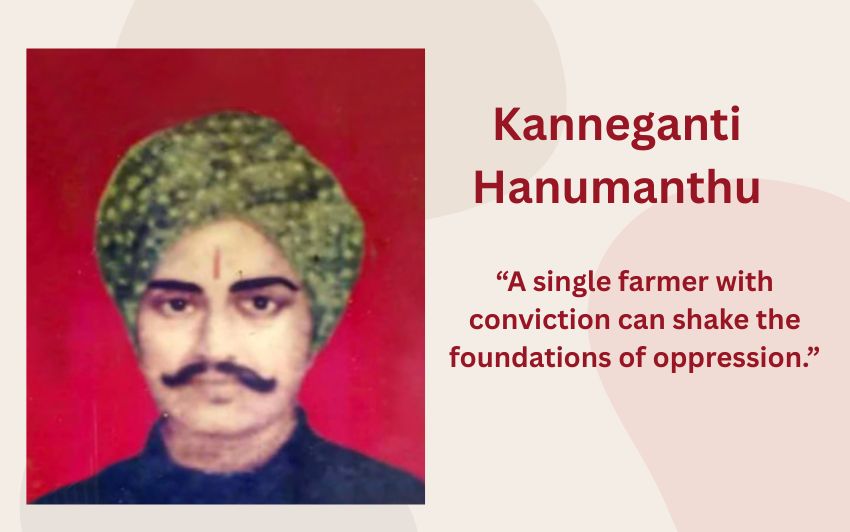
The story of India’s independence is filled with countless unsung heroes who sacrificed everything for the nation. Among them, Kanneganti Hanumanthu (1870–1922) stands out as a legendary figure in Andhra Pradesh’s freedom struggle. Known fondly as “Andhra Shivaji”, he became a symbol of peasant resistance against oppressive British taxation. His defiance, his courage, and his ultimate martyrdom during the Pullari Satyagraha inspired generations and continue to echo in the memory of rural Andhra.
This biography expands upon his life—from his humble beginnings to his heroic sacrifice—exploring not only his personal story but also the broader social and political context that shaped his actions.
Early Life and Family Background
Kanneganti Hanumanthu was born around 1870 in Minchalapadu, a small village in Durgi Mandal, which today falls in Palnadu district, Andhra Pradesh. He belonged to the Kapu agricultural community, traditionally farmers deeply tied to the land.
His family, like many in the village, lived under constant economic strain. The British colonial system imposed heavy land and forest taxes, making survival extremely difficult for small peasants. From his childhood, Hanumanthu witnessed the injustice of colonial policies, where farmers had to struggle just to feed their families, while the produce of their land was taxed and exploited.
Despite limited formal education, he grew up with practical wisdom, courage, and leadership qualities. Village elders often recalled how young Hanumanthu showed a natural ability to unite people and resolve disputes fairly. These traits would later make him the natural leader of a resistance movement.
Education and Early Influences
Hanumanthu’s formal schooling was minimal, but the rural environment became his teacher. He absorbed knowledge through community interactions, folk traditions, and the wisdom passed down from elders.
Two influences deeply shaped his outlook:
- Peasant Life – Living amidst poverty and hardship, he understood the suffering of farmers and workers.
- Oral Traditions and Folk Tales – Stories of valor, particularly those of Shivaji Maharaj, filled his imagination. The tales of resistance against foreign rule planted the seeds of nationalism in him.
From a young age, he was disturbed by the unfair treatment of farmers at the hands of British officers and local revenue agents. His determination to fight injustice began to crystallize during his youth.
British Oppression and the Pullari Tax
By the early 20th century, the British had established strict control over forests in Andhra Pradesh. They introduced a cruel levy called the Pullari Tax, which required villagers to pay whenever they collected firewood, grazed cattle, or used forest resources.
For poor farmers, this was devastating. Firewood was essential for cooking, and grazing land was necessary for cattle. The tax symbolized not only economic exploitation but also loss of dignity and self-reliance.
Hanumanthu saw firsthand how families were pushed into deeper poverty by this system. Villagers were fined or beaten for failing to pay. Out of this injustice arose the seeds of a revolt.
Formation of the Pullari Satyagraha (1921–1922)
Inspired by Mahatma Gandhi’s call for non-cooperation and satyagraha, Hanumanthu decided to mobilize his people against the Pullari tax. The movement became known as the Pullari Satyagraha.
Hanumanthu urged the villagers:
- Refuse to pay the tax.
- Boycott British officers socially—no food, no water, no service from barbers or washermen.
- Stand united as farmers and workers to resist exploitation.
His ability to bring together not just farmers but also Chenchu tribal communities of the Nallamalla Hills made the movement powerful. For the first time, peasants realized that they could challenge the British through unity.
British Response and the Bribe Attempt
The success of the Pullari Satyagraha alarmed the British authorities. To suppress it, the district collector T.G. Rutherford approached Hanumanthu with an offer. If he abandoned the movement, he would be rewarded with zamindari rights over 45 villages—a powerful and lucrative position.
Hanumanthu rejected the bribe with scorn. He asked the famous rhetorical question:
“Have you ever irrigated the land, or planted a seed in your life? Have you ever harvested or threshed a field? Why should I pay you tax for what is mine?”
This fearless response spread like wildfire among villagers, boosting morale and making him a hero.
Betrayal and Arrest
The British, frustrated by their failure to silence him, turned to force. On 22 February 1922, during the Maha Shivaratri festival, Hanumanthu and many villagers were engaged in celebrations.
Taking advantage of this, British police entered Minchalapadu, confiscating cattle and harassing women and elders. Hearing of the atrocities, Hanumanthu rushed back to protect his people. But a local Karanam (village official) betrayed him by informing the police of his movements.
He was soon surrounded and captured.
Martyrdom
Hanumanthu faced his arrest with courage. When he refused to bow down, the British officers ordered him to be executed. He was shot 24–26 times.
Even as his body was riddled with bullets, Hanumanthu continued to chant “Vande Mataram” for nearly six hours, refusing to let go of his spirit of defiance. Villagers who tried to approach him were beaten away, and he was denied even a drop of water.
On that day, he gave his life, becoming one of the earliest martyrs of Andhra Pradesh’s peasant struggles. His funeral rites were performed four days later by his grieving wife and family.
Impact on the Freedom Struggle
Hanumanthu’s sacrifice had a lasting impact:
- Spread of Anti-Tax Resistance – Villages across Palnadu and beyond joined the satyagraha.
- Inspiration for Farmers’ Movements – His defiance encouraged later agrarian protests in Andhra.
- Symbol of Gandhian Spirit – Though not formally trained, his methods of non-payment and boycott reflected Gandhian non-cooperation.
His martyrdom proved that even peasants in remote villages could stand as equals against the mighty British Empire.
Legacy and Remembrance
Kanneganti Hanumanthu is remembered as Andhra Shivaji, a title that reflects his bravery and leadership. His story lives on in:
- Poetry and Literature – The great poet Gurram Jashuva and others immortalized his name.
- Statues and Memorials – Several towns in Andhra Pradesh honor him with statues and annual celebrations.
- Folk Memory – Villagers continue to sing ballads of his defiance during festivals and gatherings.
- Freedom Struggle Narratives – He is recognized as one of the earliest martyrs of Andhra Pradesh in school textbooks and public commemorations.
Conclusion
Kanneganti Hanumanthu’s life reminds us that true heroism is not born from wealth or privilege but from courage, conviction, and sacrifice. In refusing to pay unjust taxes, in rejecting bribes, and in facing death with chants of “Vande Mataram,” he embodied the spirit of resistance.
Though his life was cut short, his legacy as the Andhra Shivaji lives on—an eternal symbol of justice, defiance, and patriotism.