
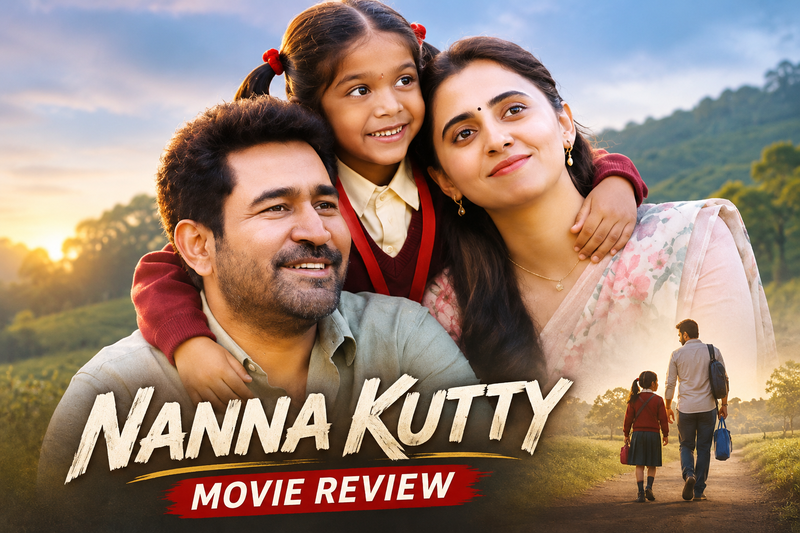
Vijay Antony’s Nanna Kutty attempts to deliver an emotional story centered on the bond between a man and a little girl. While the film has a few touching moments, effective performances and an emotional climax, its slow narration and excessive melodrama prevent it from making a strong overall impression.
The story follows Surya (Vijay Antony), a man from Vizag who moves to Ooty after a dispute. He begins living there while taking up various odd jobs and raising a young girl named Diya (Baby Lithanya) on his own. Diya’s schoolteacher, Anitha (Preethi Asrani), gradually develops feelings for Surya. However, revelations surrounding Diya’s identity and Surya’s connection to her bring unexpected developments into the story.
Performances and Emotional Moments
Vijay Antony once again chooses a story that relies heavily on emotions. Following the approach seen in some of his earlier films, he tries to connect with audiences through the relationship between the central characters. In Nanna Kutty, his portrayal of a man determined to take care of a little girl is convincing, and several scenes involving the two generate genuine emotional impact.
Baby Lithanya delivers a noteworthy performance as Diya, while Preethi Asrani makes a good impression as Anitha. Her character receives sufficient screen time, and the supporting cast also performs reasonably well. A few comedy sequences provide some relief, and the emotional climax stands out as one of the film’s better portions.
A Weak and Overstretched Screenplay
Despite these positives, Nanna Kutty struggles to maintain audience interest throughout its runtime. The screenplay follows a predictable path during the first half, with several scenes failing to create the impact required to move the story forward.
Although the second half introduces an interesting sequence, the film soon returns to a slow and unengaging narrative. The emotional scenes are frequently pushed into excessive dramatization, weakening the moments that otherwise could have worked effectively. The repeated use of the “Nanna Kutty” dialogue also becomes tiring after a point and could have been handled with greater restraint.
Technical Aspects
The film is reportedly inspired by a real-life incident, but director MU Maaran does not translate the premise into an engaging cinematic experience. The overall presentation sometimes feels closer to a television serial, with several scenes appearing unnecessarily prolonged.
The production quality is decent, and Rajeev Rajendran’s cinematography is one of the film’s positives. Vijay Antony’s music is adequate, but the editing could have been sharper. The Telugu dubbing also leaves room for improvement.
Verdict
Nanna Kutty has some sincere performances, touching emotional scenes and a few effective twists. However, the lengthy narration, repetitive dialogue and overdramatic treatment of several sequences make the film less engaging than expected. It has moments that work, but the overall experience remains disappointing.